Saturday, April 18, 2026

NEET an increasing “wicked social problem”

Two years ago (10-11 March 2014) Romania was hosting in cooperation with the European Commission the conference “Keeping Young People in Employment, Education and/or Training: Common challenges – Shared Solutions”.
The main aim of the whole meeting being to enhance cooperation and exchange good practices in education, training and employment that can lead to efficient early public interventions for supporting young people in NEET situations.

Two years later, the situation hardly shows any improvements, the European Youth Guarantee Scheme overall doesn’t show clear results, while countries like Romania didn’t even make it functional.

In 2014, when I was still acting as the President of the National Youth Council, I was advocating for investing in NGOs, youth workers and community services, everything that would have a concrete impact for the young NEETs and would reach them in the very places they live in.
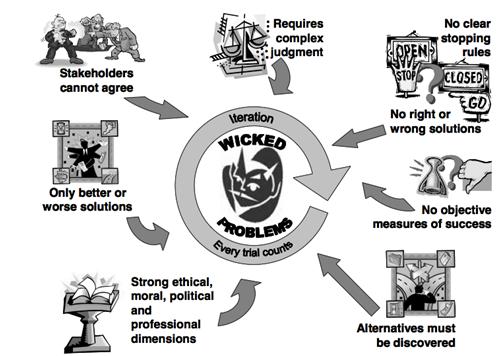
How-to-recognize-a-wicked-problem-based-upon-Rittel-and-Weber-1973-1984But since nowadays, those ideas are still “wishing thoughts” is important to look back at the presentation of Bob Coles, “NEET as wicked social problem“, because behind numbers NEET is not the same as Youth Unemployment, it’s much more.
What is a “Wicked social problem”?
NOT – evil or bad; or simply “cool” BUT
“A wicked problem is a social or cultural problem that is difficult or impossible to define and sometimes difficult or impossible to solve”  (EXAMPLES – climate change, flooding, poverty, …. and NEET).

And while is much easier to define boxes that you can check, if you want to find a real solution it’s important to remember that NEET is:

  • Complex and multi-factorial (NOT a single issue)
  • No single cause (complex multi-causal)
  • Requiring disaggregated and multiple solutions
  • Likely to require partnership arrangements (and alliances between different agencies) to have any significant impact
  • Likely to be fairly intractable and require a commitment to complex and long-term interventions

In our endeavor to contribute to this issue we’ve initiated the NGO Coalition for the Rights of Young NEET – an initiative which started in Romania in 2015, but which should continue and be expanded European wise, if we honestly want change the situation of the the young people in these situations!
Furthermore we’ve developed a quality research, having at it’s core 22 study cases of young people in NEET situations “Social Costs of Young People in NEET Situations, a Romanian Overview”, and while is good to have common measures (like the European Youth Guarantee) and learn from shared experiences, we definitely need a local “tailored approach” to ensure cost-effectiveness of the the proposed measures.

For all this we need to invest in more quality research all over-Europe, to better understand the specific realities of young NEETs and understand who are the most suitable actors to work for them!

Looking forward to initiatives where Social Justice and Young NEETs are more than “political talks”.

TC on Structured Participation in Democratic Processes, Tunisia_ddl. 21 March

Social DOers encourages young people, aged 18-30 years old, actively  involved in a youth organisation and interested in the European-Mediterranean cooperation to apply for this great opportunity, offered by the North-South Center!

As participants in the first edition of this Training Course (in 2014,) we are strongly support initiatives promoting MedUni2014youth participation in the Euro-Med Region!

This training course will focus on the development of competencies of youth workers/activists involved in civil society organisations in Europe and Southern and Eastern Mediterranean.

The course is addressed to young people from Europe (CoE member States) and Southern and Eastern Mediterranean.
Participants should fulfil the following criteria:

  • Actively involved in a youth organisation (local, national, regional, international) as representatives, volunteers, trainers and/or youth workers;
  • Aged between 18-30 years old;
  • Being involved in an organisation, project or initiative that aims at the participation of young people in democratic governance/decision and policy making;

Main Objective
To support youth organisations and activists with a view to improving their capacity to become fully fledge actors of governance in Southern Mediterranean.

Expected results:

  • 20 young activists are trained and equipped with tools related to Structured Participation;
  • Quadrilogue actors are mobilised to participate in panel discussions addressing the target group and tackling pertinent, relevant and topical themes related to Structured Participation;
  • Proposals and recommendations for improved dialogue and interaction are put forward by participants;
  • Young people and youth organisations develop joint actions with other quadrilogue actors or between peers and promote intra and inter-regional co-operation;
  • Network, partnership and peer-learning between youth organisations are reinforced;

The specific objectives are:

  •   To provide training and capacity-building for young people and youth organisations, equipping participants with new principles, tools and opportunities to further develop youth organisations and with initiatives and mechanisms to promote Structured Participation;
  •   To encourage participation of young people in decision and policy-making by promoting their involvement and interaction in quadrilogue initiatives;
  •   To foster political mainstreaming of the youth-related issues and youth policy development in the Southern and Eastern Mediterranean based on shared experiences, standards and mechanisms of the Council of Europe and in light of regional needs and initiatives.
  •   To stimulate critical reflection on individual and organisational practice to promote global democratic citizenship (participation and representation in decision/policy-making);
  •   To map good practices in the development of youth structures and initiatives to promote Structured Participation in Europe and the Southern Mediterranean region;
  •   To foster Euro-Med co-operation and networking

The training activity will be organised in the framework of the 4th Mediterranean University on Youth and Global Citizenship and in parallel with other activities organised by other partners.

The application form and a detailed presentation of the Training Course can be found here!

Young Leaders Programme_ddl. 18.03.2016

Are you aged between 21 and 26 and proactive about finding solutions to the world’s most pressing problems? Are you ready to sit shoulder to shoulder with world leaders at a global forum on international development?

Apply now for your chance to be one of 16 Young Leaders at EDD 2016, speak on a high-level panel, and showcase your development work to global audiences. Young Leaders are also invited to take part in activities and workshops, share their views, draft recommendations and meet with development decision-makers from around the world.

How to apply? Applicants must show leadership and knowledge in one of the EDD 2016 topics, demonstrate expertise in their chosen field, and explain how they will represent young people at the forum.

All expenses for the 16 selected Young Leaders will be covered by the European Commission.

In order to apply and find more about the programme follow the link: http://www.eudevdays.eu/young-leaders

For any questions? Contact [email protected]

Visual explanation of what “NEET” is and what we can do

SALTO Inclusion created an animated video explaining who the young people in NEET situations are and what we can do for better integrating them: “On track – How can you(th) work tackle NEET situation”

Romania’s invisible Generation-We hit the target but we miss the point!

Arrow on red target - business concept

About Young people and rights

Arrow on red target - business concept

Working for the rights of young people in NEET situations (young people not in employment education or training) is the result of years of activism with Youth led organizations, while gradually understanding that outside of the “organized sector” there are many young people whose voice remains unheard and who seldom have the possibility to actually know their rights.
With this in mind, and in a national context of void of research or governmental initiatives, together with Social DOers we have decided to better understand what is the current situation of these young people as well as of those who already work for them (Youth Workers) and how we can support their efforts (including the organizations) in order to ensure better services for the young NEETs.

Furthermore, being actively involved at European level, we wanted to understand to what extent has Romania taken into account the recommendations of EU institutions and how it used the financial allocations.

“Young NEETs” – where are they and why do we speak about them?

Young people in NEET situations are not a new phenomenon, for many years we have worked with them or at least we have known that somewhere there are young unemployed, school drop-outs or young people who come from “disadvantaged” backgrounds (parents who immigrated to work and left their children behind, families with low income etc.). Nevertheless, we often disregard what happens with a young person who is in all of these situations-the NEET situations.

So far, reality shows that once young people get in NEET situations they mostly become invisible. They are out of public institutions’ evidence, without access to social services, and while for those under 18 there might be some institutional tracking, after this age the situation is, to say the least, uncertain (since they are not anymore registered in formal education institutions, or in the employment agencies…or anywhere else).

At the end of 2015, Romania can only estimate the number of young people n these situations (aprox. 4440.000), without specifically knowing where they are and what they do.

Therefore we are confronted with questions like – where are they and what is going on with this “Invisible Generation”?

Public institutions don’t have (yet) a permanent mechanism to reach them and, thus, they can’t offer them the services they might need.

The European funding, that has been used so far, doesn’t show efficient solutions-since 2007, when Romania started to have access to structural funding, until 2014, the percentage of young people in NEET situations increased form 13,3% to 17%.


“We hit the target, but we miss the point”

An expression used by one of the most experienced Youth Workers I have ever met and from whom I have learned what “NEET” means – Howard Williamson (also a well known professor and expert in European Youth policies).

Although the expression might trigger some smiles at first sight, it fits like a glove to the approach we’ve had so far towards the NEET issue. Much too often we have used the (already) classic measure: professional counseling-training/internships or entrepreneurship, in a context where the situation of young NEETs is very diverse: from young people who dropped out of school (before graduating from compulsory education) to higher education graduates who can’t find a job; from young people who are socially excluded (for health issues, not having support in raising their children etc.) to young people who don’t accept a job if it doesn’t meet their professional expectations.


“One size DOESN’T fit all”

Trainings or internships can’t be used as the only measure for integrating young NEETs. Efficient labor market integration needs an integrated and personalized approach, according to the particular needs of young people. Furthermore, experiences of those who have already worked with young people in NEET situations show that finding a job is not the only issue, but also keeping it. Therefore, the measures addressed to young NEETs should include a mixture of job skills development as well as a tailored approach to the personal needs, especially for those who are inactive or in NEET situations for long periods of time.

Last, but not least, we notice a need for more measures of Prevention and Early intervention.


All these issues, and much more, were at the core of our initiative “NGO Coalition for the Rights of Young NEETs-Investing in Social DOers”.

At the end of the project we are happy to say that we can better grasp the NEET phenomenon and all the results will allow us to build on everything that was achieved. Further on, we plan to strengthen the cooperation with both public institutions and youth workers, in order to ensure that young people in NEET situations have real Access to their Rights.

Veronica STEFAN

President & Co-Founder, Social DOers

Read the full study Social Costs of Young People in NEET situations, a Romanian Overview and the achieved results of the NGO Coalition for the Rights of Young NEETs, a project funded by EEA & Norway Grants through the NGO Fund in Romania!